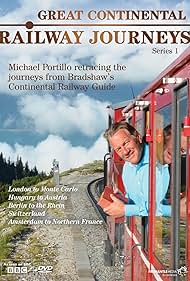
Great Continental Railway Journeys
Michael Portillo travels across the European continent with his handy Bradshaw guide book. Looking at history and trying 21st century things that changed since before The Great War...
Genre: Documentary
Cast:Michael Portillo
S1.E1 ∙ London to Monte Carlo
Michael Portillo, a former member of the British Parliament guides us through the European rail network and compares today with his 1913 edition of the Bradshaw's Continental Railway Guide.
S1.E3 ∙ Berlin to the Rhine
Michael Portillo travels by rail throughout Continental Europe. This episode offers beautiful views along the Rhine and also shows various cities in the area including Colonge and Koblenz. He carries with him the Bradshaw's Continental Railway Guide book from 1913 and compares photos of then versus the reality of today.
S1.E5 ∙ Amsterdam to Northern France
Michael travels from Amsterdam to Brussels, Mons and Amiens in Picardy France and he meets guides who explain the historic significance of the rail network and these places.
S2.E1 ∙ Madrid to Gibraltar
Michael Portillo travels to Spain, the country his father fled during the bloody civil war. He starts in the centrally located capital Madrid, Europe's highest and until a century ago uneasily accessed, focusing on the monument for a Spanish king's tragically bombed wedding to an English princess. Then he takes the super fast train to Andalusia, first stop Moorish marvel Cordoba. Next Seville, where he bought a house, and Jerez, which gave its name to the region's white wine sherry, and mountain citadel city Ronda. Finally to Alegeciras, port gateway to Morocco, and British enclave Gibraltar.
S2.E2 ∙ Turin to Venice
Michael Portillo starts his train trip trough northern Italy in Turin, capital of Piedmont and the first years of its king's newly united realm, Italy minus Rome, and home of Fiat. Next Milan, capital of Lombardy and fashion. Then lake Como, the most touristic and idyllic stop on the early British traveler's grand tour. Finally splendid Venice, home to unique monuments and the modern Biennale.
S2.E3 ∙ Dresden to Kiel
Michael starts a journey across Germany in Dresden, before the bombing a major European cultural center with star composer including Wagner, but also and the home of the back to nature, open air gym and general health movement. Still in Saxony, Leipzig, Germany's great industrial powerhouse, but also musical, with Bach and Mendelshon's foundations, conservatory and Gewandthaus orchestra. Next Brunswick, where Michael visits a beer brewery while a Hanoverian king George accepted bride Caroline from the ducal dynasty to ensure a fat allowance from parliament. Finally to Germany's major ports, first commercial giant Hamburg at the North Sea, ultimately Kiel, home at the Baltic of the imperial war fleet, both meant to rival Britannia to rule the seas and colonies.
S2.E4 ∙ Copenhagen to Oslo
Michael travels to Scandinavia, the former Vikings home countries, once controlled by mighty Danish kings, now divided in three modest, pacific nation realms, yet tied by dynastic alliances with each-other, Britain and other European great powers. He starts in the Danish capital Copenhagen, also home of fairy tale champion Hans Christian Anderson i the grand old Tivoli amusement park, a well-preserved continental pioneer. By monumental bridge to Malmö, in Sweden, and the grand cathedral of Lund, once the Northern European archiepiscopal see, and the great port of Göteborg, also a major industrial center, home of companies like Volvo and great immigrant communities, firstly Scots like Michael's mother, whose traditional dances he partakes in. Past falls turned into a pioneer hydro-electricity plant and picnic-ideal countryside to the Norwegian capital Oslo, enjoying a ski jump-akin slide ride.
S4.E2 ∙ Vienna to Trieste
Michael takes the first railroad build I the huge Austro-Hungarian empire, from imperial capital Vienna to Adriatic main port Trieste. In Vienna he indulges in grandeur and spy (hi)story, then passes the greatest Alpine tunnel of its age to Graz, rural Styria's capital and Austria proper's second city then, now remarkably modern in harmony with its Baroque heritage. Then to Lublijana, capital of Slovenia (Catholic ex-Yugoslavia) and finally Trieste, then Italian jewel in the crown of Habsburg's Veneto-provinces.
S4.E3 ∙ Pisa to Lake Garda
Michael does part of the Italian Grand Tour, the precursor of Victorian 'mass' tourism, along Italian art cities. He starts in port city Pisa, discussing the leaning campanile. With a side-trip to Carrara, where unsurpassed marble for statues is cut, he heads for the highlight, Tuscan capital Firenze (Florence), with particular attention for the effects of its short-lived status as Italian royal capital between the Piemontese dynasty's Turin and eternal, imperial and papal Rome. Finally off to the ultimate holiday region of the grand lakes, at Lake Garda.
S4.E4 ∙ Athens to Thessaloniki
Michael makes a Greek odyssey from Athens's port of Piraeus to the city of Thessaloniki visiting the Acropolis, the Corinth Canal, Delphi and the little train of Pelion one of the world's narrowest gauge railways.
S4.E5 ∙ The Black Forest to Hannover
Armed with his 1913 Continental Railway Guide, Michael Portillo ventures deep into the Black Forest on a quest to discover the essence of Germany and discovers how Hansel and Gretel helped to unify the nation. A humbling masterclass in carving cuckoo clocks shows.
S5.E1 ∙ Transylvania to the Black Sea
Michael Portillo ventures east through Romania. In Constanta, Michael loads cargo from a 100-foot crane.
S5.E2 ∙ Zermatt to Geneva
Michael Portillo is rescued from an 'avalanche' by a St Bernard puppy. On his next stop, Michael is caught up in a war zone with the Red Cross.
S5.E3 ∙ Tangier to Marrakech
Michael Portillo takes in the sights, smells and tastes of North Africa.
S5.E4 ∙ Genoa to the Brenner Pass
Michael takes trains trough northern Italy, which was only partially integrated into the present country. He starts in Genoa, the world class main port of Liguria, with grand monuments from its golden age around 1700 and later industrial boom. Next along the Italian Riviera to the luxury marina resort of Portofino, key in the occupation of Libya and preserved miraculously thanks to a Britton, finally to the vast naval base of La Spezzia. Up the Po plain to ancient university city Parma, famous for its aged ham. Then to Trento, capital of a part of Tyrol Austria lost in World War I. Finally to the Alpine town of Brenner, which gave its name to the mega-tunnel at the Swiss border.
S5.E5 ∙ Riga to Tampere
Michael Portillo ventures to the northernmost reaches of Europe.
S5.E6 ∙ Rotterdam to Utrecht
Michael Portillo discovers the magnificent art and architecture of the Dutch Golden Age.
S6.E1 ∙ Kiev to Odessa
Michael Portillo explores the city described in his guide as the 'Jerusalem of Russia', then fulfills a lifelong ambition to visit the Black Sea port of Odessa.
S6.E2 ∙ Batumi to Baku
Michael begins in the port of Batumi on the dazzling Caucasian Riviera, then traverses the 120-mile Georgian Military Road, built in the early 19th century.
S7.E1 ∙ Salamanca to Canfranc
Michael Portillo sports a modern edition of his Bradshaw's Handbook as he heads for Spain.
S7.E2 ∙ Orleans to Reims
Michael visits the magnificent stained-glass windows of the Cathedral of Sainte-Croix.
S7.E3 ∙ Berlin to Stuttgart
Michael hears how new rail lines transported spectators to the Nazi Olympic Games of 1936.
S7.E4 ∙ Palermo to Mt Etna
In Palermo, Michael takes in the art and architecture of the futurists.
S7.E5 ∙ Linz to Bratislava
Michael travels through Austria and the Czech Republic, exploring a dark era in history.
S7.E6 ∙ Stockholm to the Arctic Circle
Michael celebrates Midsummer in Marielund and learns to decorate a Dala horse in Mora.
