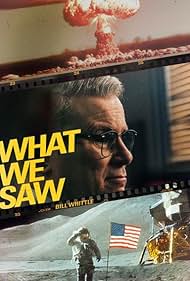
What We Saw
Neil Armstrong and Buzz Aldrin's historic 1969 moon landing, the pinnacle of America's space race fascination, is explored through the eyes of those who witnessed Apollo 11's achievement.
Cast:Bill Whittle
S2.E1 ∙ Part 1: An Iron Curtain
The Cold War started in the same place that World War II ended: Berlin. On the Eastern side, the collectivist, state-centered world of Joseph Stalin's communist ideology, armed to the teeth with conventional forces. On the Western side was a war-weary alliance of capitalist countries, led by the beacon of individual rights, the United States. Part 1 of What We Saw: The Cold War, peels back the layers of mystery cloaking the terror state run by the Kremlin, and watches America taking its first small steps onto the stage of world leadership.
S2.E2 ∙ Part 2: Two Bombs
After the defeat of Nazi Germany, the fragile alliance between the Allied countries in the west and Stalin's Red Army, came to an end. Stalin looked for opportunities to expand communism, hoping America would withdraw its troops.
S2.E3 ∙ Part 3: The Thing Begins
Immediately following World War Two, Germany was divided into four parts: British, Russian, American and French. Berlin was divided the same way, however it was embedded in the Russian zone of occupation.
S2.E4 ∙ Part 4: The Forgotten War
A brilliant amphibious landing turns the tide on the Korean Peninsula; meanwhile, America raises the stakes with a bomb so powerful it takes an atomic bomb to simply light the fuse.
S2.E5 ∙ Part 5: Death In The Kremlin
As the knives come out for the succession fight inside the Kremlin, will a brief window of opportunity be enough to completely reset the conflict?
S2.E6 ∙ Part 6: What We Ike
With enough persuasion General Eisenhower would become President Eisenhower, and face a brace of Soviet leaders. But no one was prepared for the anti-military, anti-war policies from the man who'd fought so hard just a few years before.
S2.E7 ∙ Part 7: Playa Giron
Fidel Castro's first and greatest test would be to repel an American-backed invasion at Playa Giron, a beach on the southern coast of Cuba at the mouth of an inlet called the Bay of Pigs.
S2.E8 ∙ Part 8: To The Precipice
As US Navy warships intercept incoming missiles, the fate of the world hangs in the balance -- and is ultimately in the hands of one man, not in The White House or the Kremlin, but beneath the waves at the edge of the quarantine zone.
S2.E9 ∙ Part 9: Cloaks and Daggers
With the mechanisms of apocalypse firmly in place, both sides accelerate their efforts to determine the actual capabilities of the other. But The United States and the Soviet Union diverge in regard to intelligence gathering.
S2.E10 ∙ Part 10: Welcome to the Suck
Once the immensity of the war in Vietnam hit, someone with more time on the ground might greet them with a wry "Welcome to the suck." An apt name as any for the burgeoning war fought to contain communism in Vietnam.
S2.E11 ∙ Part 11: From the Jaws of Defeat
Mired not only in the jungles of Southeast Asia but, but from outdated, rigid doctrine, fossilized tactics, and declining morale, a light appears in the middle of America's darkest night.
S2.E12 ∙ Part 12: The Liberators
A change of command comes too late to reverse the situation in Southeast Asia as Richard Nixon's program of 'Vietnamization' eases America out of its worst-directed war.
S2.E13 ∙ Part 13: A Pizza Hut Parade
America's oldest President brings youthful vigor, renewed optimism and a plan to resolve the forty-year running stalemate and end the Cold War with a win.
